The long awaited debut LP from NYC’s FLOWER “Hardly A Dream” is finally set to arrive.
FLOWER’s tedious approach to writing/creating/drawing their debut LP was carefully thought out and the result is a monumental anarcho punk /crust record.
“Hardly A Dream” Takes us on a bleak journey through the dark side of society. As soon as you drop the needle a dark atmosphere is immediately created with a slow intro featuring arpeggio guitar work that builds into pummeling d-beat crust. The albums vocals then leave you with a feeling of being crushed by the ever-present weight of living through our modern world of late stage capitalism that was built on the falsehoods of the so called American dream, religious hypocrisy’s, nationalism, and the greed of humankind.
FLOWER take many cues from predecessors and are most often (and rightfully so) compared to NAUSEA but they also take a heavy influence from ANTISECT, SACRILEGE & other greats. The artwork has a very RUDIMENTARY PENI feel and the record comes with an amazing 24.5 X 34.75 CRASS style poster jacket. All art work was meticulously hand drawn and overseen by the guitarist Willow in true DIY style and spirit. Willow was also cool enough to draw up a special shirt for the record release featuring an alternative PROFANE EXISTENCE backprint!
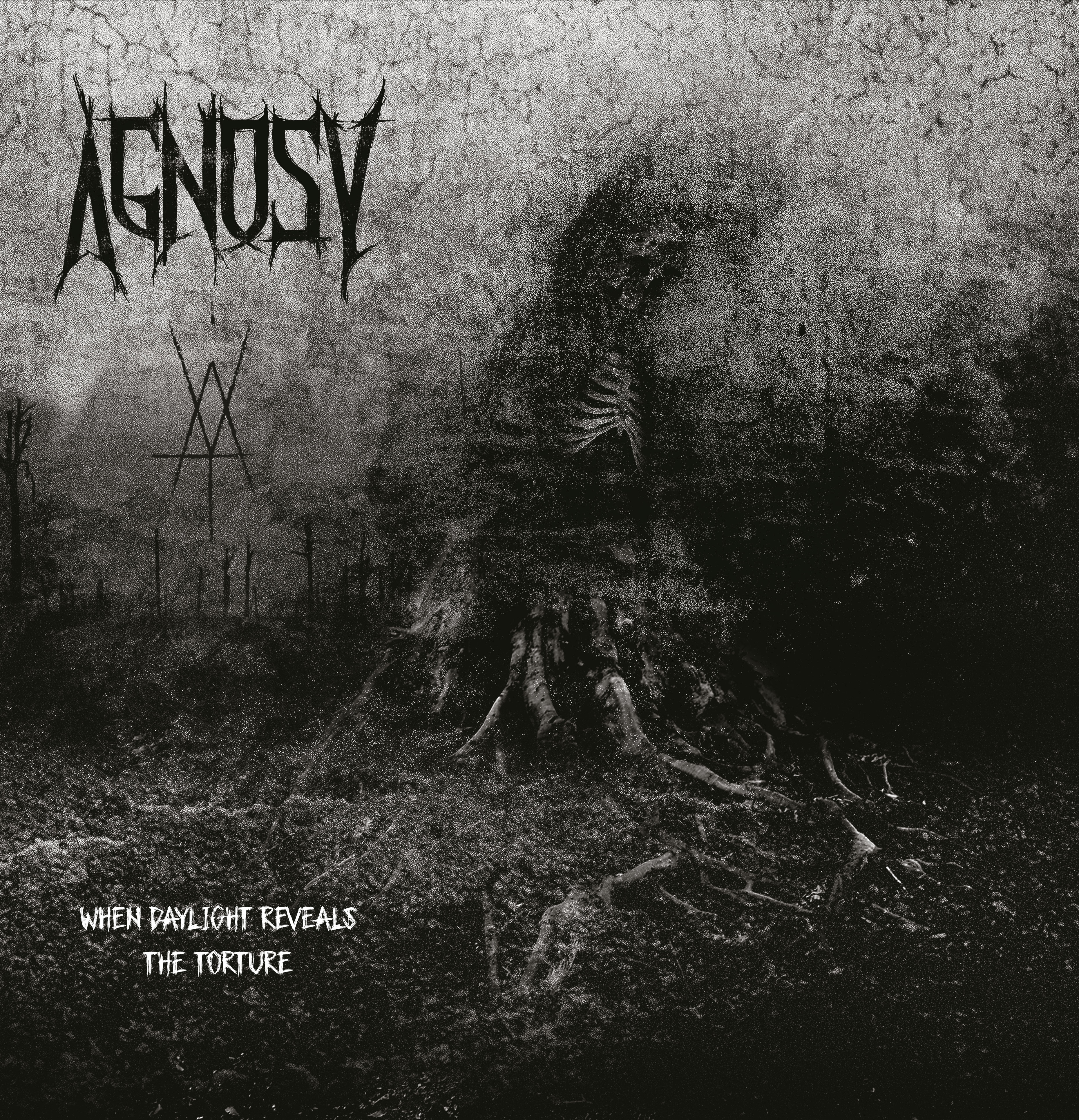
Dark, heavy, galloping crust from the streets of London. AGNOSY is back to present us with a ferocious beast of an album that can only be forged by the anger and frustration of living in today’s world. “When Daylight Reveals The Torture” aggressively attacks evils such the current rise of fascism and animal abuse. It intelligently and passionately touches on the Afrin invasion and the revolution in Rojava and shows nothing but utter disgust toward the arrogance of humankind’s lust for greed and power that will inevitably lead us down paths of war and environmental devastation.
AGNOSY – Live at SCUMFEST in London. 2011
While lyrically AGNOSY are much more politicly straight forward this time around than on previous releases, musically they have expanded on their sound to create a dark and moody atmosphere while at the same time staying crust as fuck. To say they know what they are doing would be an understatement from this band of vets whose members have played in HIATUS, HEALTH HAZARD, and BEGINNING OF THE END.
Long galloping intros are followed up by traditional d-beat, fierce solo’s are then meet with vicious vocals and pulverizing bass in a brilliant recording captured by Lewis Johns at The Ranch Production House and was mastered by Brad Boatright at Portland’s legendary Audiosiege. We then pressed on deluxe heavyweight 150-gram vinyl, printed on reverse board jackets, and included an 11in x 22in gatefold insert to bring you a high quality and truly epic record.
PROFANE EXISTENCE – PO BOX 647 – HUNTINGTON WV – 25711 – UNITED STATES
The legendary crust classic is now available once again!
Authorized and released in cooperation with MISERY, S.D.S., & MCR Japan & Remastered by Jack Butcher at Enormous Door Studio we are beyond proud to make one one the most rare and sought after crust records available once again.
Fuck the scavengers charging punks exuberant amounts of cash on ebay and discogs. We worked meticulously with both bands and with Jack at Enormous door to bring you an updated version that kicks major audio ass while maintaining the original authenticity.
Released on deluxe 150 gram vinyl. With an 11×11 inner sleeve. Black Paper Jacket. Reverse Board Jacket.
Earlier this year we re-issued this legendary LP and sold over 950 copies in just 4 short months. For this second pressing we pressed 490 copies on Krystal Clear & 485 on Grey Vinyl with Black Mist.
Crystal Clear (Bullet belt no included) Grey With Black Mist (Bullet belt no included) PROFANE EXISTENCE – PO BOX 647 – HUNTINGTON WV – 25711 UNITED STATES
Stench crust the way it was meant to be played!
The UK crust scene of the 1980’s inspired band after band but no other band has ever reincarnated the sound of that time as well as SWORDWIELDER. Quite simply if you like crust, then this the album you have waited decades for.
Review by Craig Hayes from “Your Last Rites”… Swordwielder – System Overlord Heavyweight punk fanatics take note: System Overlord is a fucking triumph. The long-awaited sophomore album from Gothenburg stenchcore band Swordwielder is a brooding behemoth, constructed from the filthiest and heftiest strains of punk and metal. System Overlord shimmers with apocalyptic visions, and it’s overflowing with all the grim atmospherics and intimidating intensity that defines consummate crushing crust.
Too much hype? No way… And no apologies, either. Swordwielder deal in definitive stenchcore on System Overlord, and much like their full-length debut, 2013’s Grim Visions of Battle, the band’s latest release is a knockout. Swordwielder’s harsh, gruff and dark sound owes a significant debt to old school icons like Amebix, Axegrinder, Deviated Instinct, and Antisect, and they mix and mangle their influences and leave ’em to rot on the battlefield.
Plenty of hammering rage drives System Overlord tracks like “Violent Revolution,” “Savage Execution” and “Cyborgs,” and thundering epics like “Corrupt Future” and “Northern Lights” exhibit subtler strengths, mixing guttural growls and clean vocals with crashing percussion and dirge-laden riffs. Connoisseurs of corpse-dragging crust will love the brute-force belligerence of “Absolute Fear,” “Nuclear Winter,” and “Second Attack,” which rain down like merciless mortar barrages. As a rule, all of System Overlord‘s mammoth tracks chug and churn with grinding muscle, while reeking of squalor and decay.
Swordwielder exudes tightly coiled aggression from start to finish here—songs rise from the ashes of desolation, and resounding calls for action and resistance ring loud. If you’re a fan of heavy-hitters like Fatum, War//Plague, Carnage, Zygome, Cancer Spreading or (insert your favorite hefty crust crew here), System Overlord‘s trampling tempo and strapping sound are bound to appeal.
WILT combine old school metal and crust in a perfect hybrid that very few others have ever achieved. Prepare for a LP thats equal parts galloping d-beat crust reminiscent of bands like HELLSHOCK, and INSTINCT OF SURVIVAL, meets old school death metal in the vein of BOLT THROWER, MEMORIAM (old) SEPULTURA.
Here is a track from the upcoming LP
“Sermon for the Bootlickers”
Despite the inculcation of helplessness within each there remains great power. Ill at ease with such makes us ill. Learn to see the hand that feeds for what it is. You’ve been fooled if you think you’ve got no power. Refuse to be reduced to a consumer you’re a human being. Define yourself by more than wealth. Define yourself as a human. You don’t need what you’re being sold. Bend your knee to no authority but your own mind. You have the power to avoid the gilded trap. Avarice is what you’re conditioned for. Break the mold discover what’s really valuable to you.
WILT will be on in Europe this July / August will ELECTROZOMBIES From Chile
Wed, July 12 Hanover / Germany / Confirmed Thu, July 13 Bremen Fri, July 14 Mulhem / Germany / Confirmed Sat, July 15 Gent, Belgium / CrustPicnic / Confirmed Sun, July 16 Paris / France or Amsterdam / Nederland July 18 North-East France or West Germany July 19 Freiburg / Germany TBC July 20 Winterthur / Switzerland Fri, July 21 Zurich / Switzerland Sat, July 22 Biel / Switzerland July 23 Lausanne or Geneva / Switzerland
July 24 Geneva / Switzerland or Grenoble france
July 25 Treviso (or Milano or Bologna or Verona) / Italy
July 26 Ljubljana Slovenia Confirmed
July 27 No Sanctuary chilling day
Fri, July 28 NoSanctuary Confirmed
Sat, July 29 NoSanctuary Confirmed
July 30 Ilirska Bistrica/Slovenia or Vienna/Austria or Budapest/Hungary.
July 31 Wiena / Austrai or Budapest or / Slovakia
August 1 Brno / Czech Republic.
August 2 Prague / Czech Republic
August 3 Finsterwalde / Germany TBC
Fri, August 4 Leipzig / Germany TBC
Sat, August 5 Berlin / Germany / confirmed
August 6 Dresden
August 7 Wroclaw / Poland
August 8 Warsaw / Poland
August 9 Poznan / Poland
August 10 Szczecin/Poland TBC
Fri, August 11 Rostock / confirmed
Sat, August 12 Hamburg TBC
For this in the Seattle or surrounding area you can catch WILT this Saturday April first at Highline Bar with NOOTHGRUSH from Oakland.
Punk rock cultures are rife with radical potential, aesthetic shock, and a diversity of visuals, sounds, ideas, spaces, and people. As is often the case with interesting cultural scenes, aesthetic movements, and political ideas, punk is also rife with contradiction. On such perplexing contradiction is the incredible diversity of people and places that punk occurs in. In my participation in various punk scenes in the U.S. and U.K., I usually inhabit a plethora of the putrid, damp, overcrowded basements, abandoned, dilapidated, and repurposed warehouses, the many hidden scabies-infested squats, and the piss-covered floors of pubs usually associated with punk’s underground. Yet, punk exists other types of spaces as well, and Dial House is one such example. I visited Dial House this summer because it is one of the most central, iconic sites of the anarcho-punk scene in England. For the benefit of anyone who may not know, a group of radical artists and writers has lived in this Victorian cottage in Essex on the edge of Epping Forest for over forty years, but Dial House is undoubtedly most widely known as the headquarters and home of the anarcho-punk group Crass, which existed from 1977 until 1984, and their record label which still does. They have also maintained what they call an ‘open house’ policy, inviting all travelers in need of shelter and food for a night to their home. This is the story of my first trip to Dial House and the wonderful reception I received there.
I set out from London early in the morning after a breakfast of soggy toast, a banana, and some horridly stale instant coffee. By mid-morning, I had become thoroughly lost, and I thought to myself that I couldn’t be in the right place. I had spent all morning trying to find this place, beginning with a walk from my hostel bed to the nearest Underground station at Bayswater, two transfers, a central line train to its northernmost stop in Epping, and a bus to the King’s Head. I walked through the door of the plain white building under the wooden sign labeled “Library,” a happy accident, and found myself in a dimly lit room half full of chest high bookshelves. There was someone that I couldn’t see seated in an office around the rear corner and conversing with a portly middle-aged man standing in the office doorway. “Yessah? Can I help you?” he said as he noticed me walking in.
“Uh, yeah, I’m looking for Dial House. Do you know where that is?” I answered, somewhat reservedly, keeping my figurative fingers crossed.
“Right,” he said, leaning back into the office with his torso to address whoever was inside, “there was another chap earlier looking for Dial House, yeah? That’s back uh…” His voiced trailed off and I couldn’t make out the rest. He emerged confidently a moment later, and pointing his hand said, “You go down this street here, take a right, and when the street ends there’s a little path between the gardens. Then you’ll get to the highway that it’s on.”
“Thanks,” I said with a nod.
“Cheers,” he responded as I left.
I walked outside and eventually found my way to an old road, comprised of a compacted dirt and gravel clearing between two tree lines, about two car widths wide. There was no one else on the road in either direction. All I could see as I walked along this hidden road were empty fields covered in meter-high beige/yellow grass underneath an ashen grey sky. Luckily it wasn’t raining that morning, but in England dryness is only a temporary condition. Looking up, I saw the sky was so full of clouds that they all seemed to run together, creating one giant smear of grey across the canvas of the sky, as if the natural color of the sky were not blue at all. The occasional bird chirps added to my sense of isolation, as not a single car or other sign of people could be heard.
Up a little ahead I heard a rustle in the bushes, like a badger or a deer that I had startled. Instead, I saw another backpacker, dressed in black jeans, an old tattered hoodie, and disheveled asphalt-black, curly hair, in some places matted and pressed, and in front hanging down to just above his eyebrows. The matted, clumped hair suggested that he hadn’t washed in a while. His pack looked even heavier than mine (no small feat to be sure), packed full of who-knows-what, bursting at the seams, and creating a noticeable amount of stretching tension on the shoulder straps. The rustle I heard was his struggle to put it back on after having a rest. His aesthetic immediately messaged to me that he was an ally.
I noticed on his right forearm, just below the rolled up black jacket sleeve, what appeared to be an anarchist tattoo. I peered a bit closer and saw that it was indeed a circle “A”, a peace sign, and a circle “E”, the trifecta common among anarcho-punks, i.e. standing for anarchy, peace, and equality. From what I could see, his tattoos looked old and sun-faded, a sort of charcoal color of splotchy grey rather than bold black, and the colors were shaded in a more disconnected fashion than smooth black. When I looked at his face, I could see a glistening flash of metal from his nose, a thin silver ring in the left nostril. His Anglo-white skin was thoroughly tanned, like the golden brown of a well-oiled baseball glove, the color of which blended into the lines on his forehead, suggesting a lifetime in the sunlight. I called to him, “Hey, uh…are you looking for Dial House?” I was simultaneously hoping that he spoke English, and that he too was going where I was going, and perhaps even knew the way.
“Yeah, you are too?” he replied with a cough, and in an U.S. English accent, “I think it’s just up that way,” and gestured to his right. As it turns out, we had been spending our morning the same way, including stopping in at the same library to ask for directions, not ten minutes apart. He introduced himself to me as Tom, an anarchist punk from Baltimore, and a musician like me. He had even played bass in A.P.P.L.E. a few years back! On the one hand, it may seem strange that two Americans would run into each other thousands of miles from home, in the middle of a country road in Essex (imagine how the librarian must have felt that morning!), but here we were, fellow travelers on what you could call a punk pilgrimage.
“You been in England long?” Tom asked me, keeping his eyes ahead on the road, but glancing out of the corner of his right eye at me.
“About a month. You?”
“Just a couple of days, I was staying in a squat in London, but it got evicted.”
“Shit, so you really need a place to stay, huh?”
“Yeah,” Tom answered, “I got a tent, but it’d be nice to stay for a least a few nights.”
“Do you know if it’s still an open house? Will it be weird, us showing up?” I asked Tom, as now the stakes had been raised.
“I don’t know, but I think so. Even if its not, it’s kinda a bucket list thing for me, you know? Have you read The Story of Crass?” Tom asked quizzically.
“Yeah, it’s really good,” I said, wondering how much might have changed at Dial House since the book was written.
“Yeah, I just re-read it, sort of get ready, you know? What about Shibboleth?” he asked, referring to the autobiography of Penny Rimbaud, co-founder of Crass and Dial House.
“No, I’d really like to though. I can’t find it. I think it’s out of print.”
“Really?” he asked with a surprised tone, a sort of verbal octave change, seeming to suggest that he had no problem finding a copy. As we walked discussing Crass, I began to wonder what Dial House would actually be like, compared to how it is discussed, understood, and symbolized in punk cultures. Stories around their open house policy, answering all fan mail, refusal to play commercial venues, dedication to underground distribution channels for their records and maintaining low prices (i.e. they consistently listed prices on their record covers, always far lower than was typical), coupled with their espoused anarchism has lent them an air of authenticity within punk circles. Beyond the establishment of Crass’s authenticity, they have also become a metric for comparison, the gold standard for how other punks’ authenticity is often measured. With all this in mind, I was teeming with anticipation to see if their home and their lives matched both their ideals, their visual and sonic aesthetic, and perhaps most importantly, their reputation. Seeking some reassurance, I asked Tom, “I wonder if a lot of punks still come here. Do you know what’s been going on here for the last 30 years? I haven’t really kept up with their music after Crass, I don’t really know much about Last Amendment.”
“I bet people still come, I mean, look at us!” Tom answered confidently.
Looking beyond a vast open field, we could see a line of trees in one direction, but couldn’t make out what was behind them. In the opposite direction, we could see a few buildings past a rusted brown and auburn sign that read “Private Road, No Pedestrians” in scrawled, sloppy white letters, not the most promising of signs when seeking an anarchist house. Neither direction looked inviting, and my feet throbbed with each step. Along the road we passed a tall, bald man standing next to an overgrown fence. He was easily thirty years our senior, and was more expensively dressed in clean khaki slacks and a flannel grey coat. He had a backpack at his feet, and was carefully avoiding the snags of the fence that some vines were wrapped around to pick blackberries, tossing a few into his mouth every few seconds. I averted my eyes and lowered my voice when he paused briefly from his berry picking, in the event that he owned this land and would not be welcoming to two crusty travelers. We kept walking towards the cluster of buildings, hunched over from the weight of our packs, as if there was an invisible cord connecting our foreheads to our feet. With each step, we could not only hear the crunch underneath our boots, but also the sounds of stretching fibers in our shoulder straps.
“Which way? Does this look right to you?” Tom asked.
“I’m not sure. I don’t really think it’s close to any other buildings though, do you? I’ve only seen pictures of it from the back. I guess I always thought it was pretty isolated,” I replied, as I pointed to a cluster of tall farm buildings fifty feet ahead. I had started to wonder silently if this was such a good idea to come here.
“No, I don’t think that’s it,” he replied with a slight, dejected sigh.
Now a smell of dampened air joined the cloudy sky and increasing wind; yes, rain would be upon us shortly. And we were in the middle of nowhere. We were looking for a place neither one of us knew how to find, and I’m not even sure I could find my way back to the King’s Head bus stop. We turned back the other way, followed the road back to the fork, and went the other direction past the trees. Roughly thirty minutes later we decided we had made a mistake. We stood in the middle of the road, looking at each other with blank, disappointed faces.
“What about that guy we passed earlier?” Tom asked, “Maybe he knows.”
“Good call,” I replied, “worth a shot.” We turned back down the way we came, and in a few minutes, saw the older man walking towards us.
“Are you looking for the same place we are?” I inquired, somewhat reservedly.
“Probably,” replied the older man.
“Dial House?” Tom added.
The man responded with an affirmative groan, “Mmmm.”
“Us too,” said Tom, “What’s your name?”
“Bill.”
“I’m Tom.”
“Andrew,” I added.
“You’re American, yeah? Where you from?” Bill asked.
“I’m from Baltimore,” Tom said.
“California for me,” I interjected to answer Bill’s questioning gaze.
“So,” he paused his speech and slowed his stride a bit, “you don’t know each other?”
“No,” I said with a muted laugh, “we just met.”
“What about you, where are you from?” asked Tom.
“Well, I’m English, but I live in Morocco,” Bill answered.
“Have you been here before?” I asked, secretly hoping that he knew where the hell he was going.
He raised an eyebrow, gave a quick cluck of a laugh, and said, “hmmm…I’ve been coming here for forty years.”
Our luck seemed to have picked up, and we had now inadvertently found a guide to follow! He could tell we were exchanging surprised looks and Tom said, “Wow.”
“I was with Gee at art school,” Bill explained, referring to Gee Vaucher, a Dial House resident and co-founder.
“I’m gonna shit if it’s right behind where we just were,” I whispered to Tom.
“I know, right?” he replied.
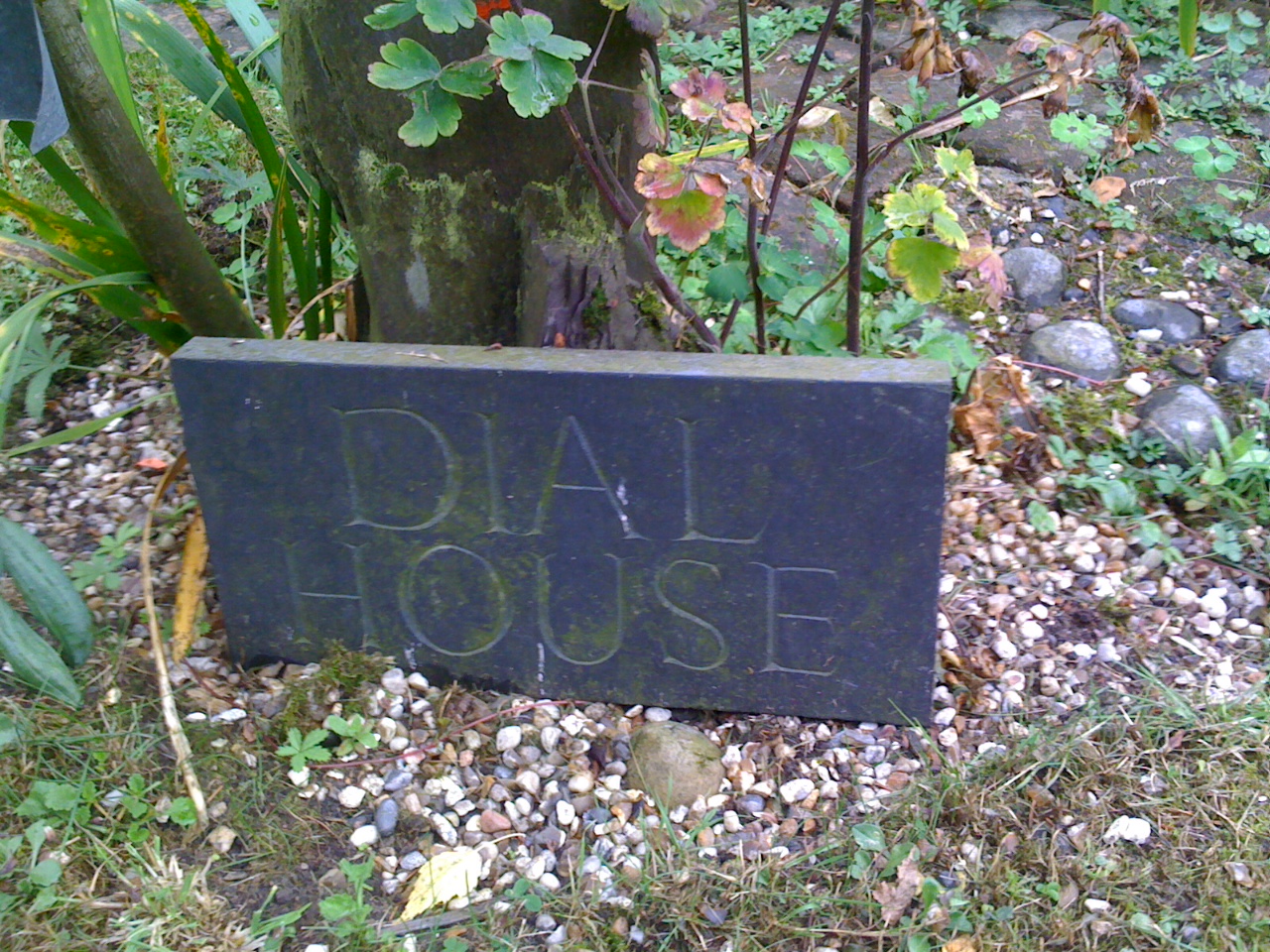
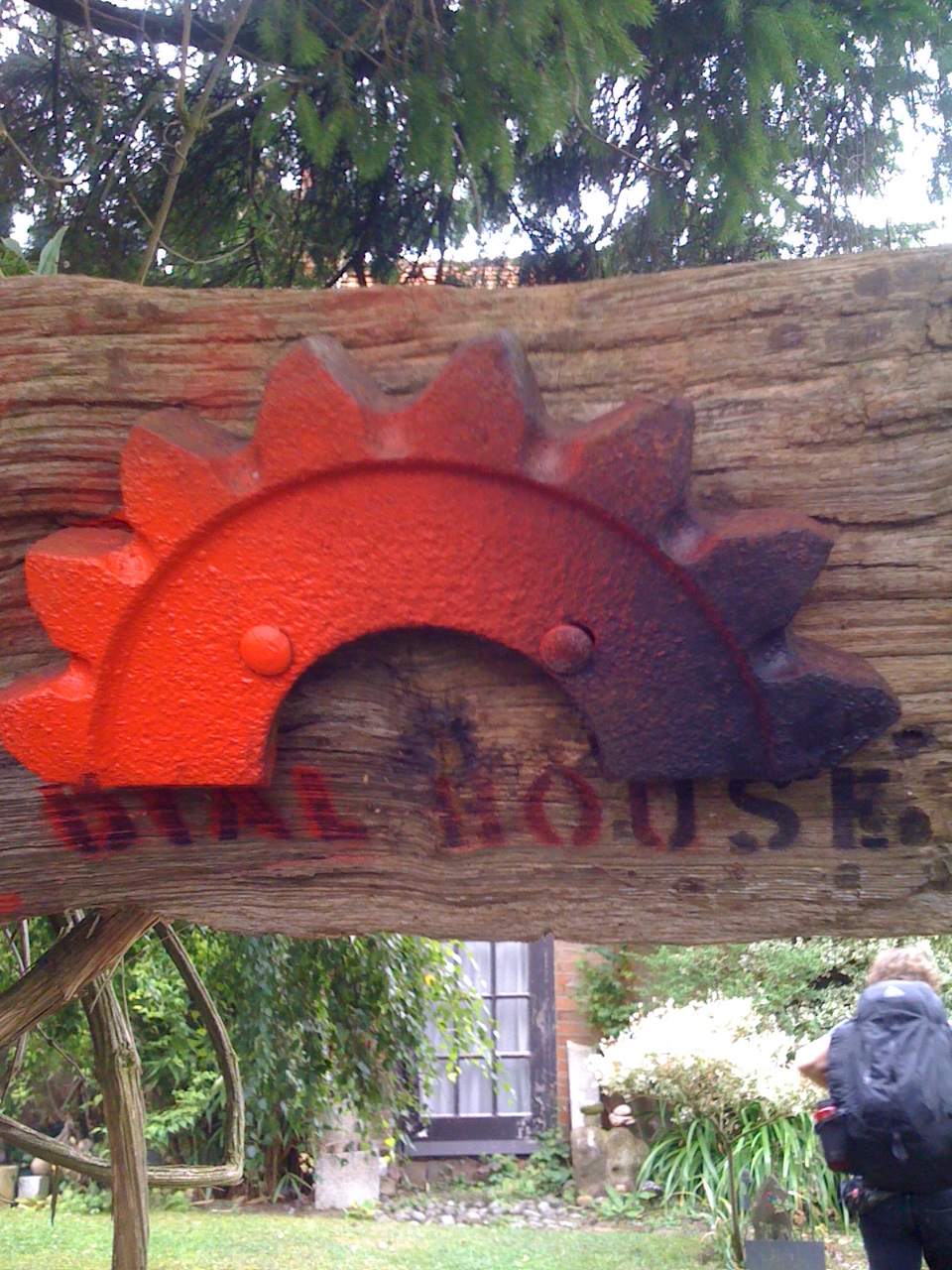
As it turned out, just beyond the cluster of buildings we had turned away from, Bill led us to our destination. We arrived at an old, lop-sided and unpainted wooden gate gate adorned with what appeared to be a 19th century gear spray painted red (though with a rough and wrinkled texture underneath the recent coat of paint that suggested rust), emblazoned underneath with the cherry-red stenciled words “Dial House.” We had arrived. I had seen dozens of pictures in books and zines, but always from the back garden. I suppose my affinity for Crass and my knowledge of how many people had lived here had colored my mental image of Dial House, and I’d always pictured this house as much bigger in my imagination. Bill just walked in like he owned the place and barked, “Close the gate!” to me. He walked in the door with a quizzical, “Hello?”
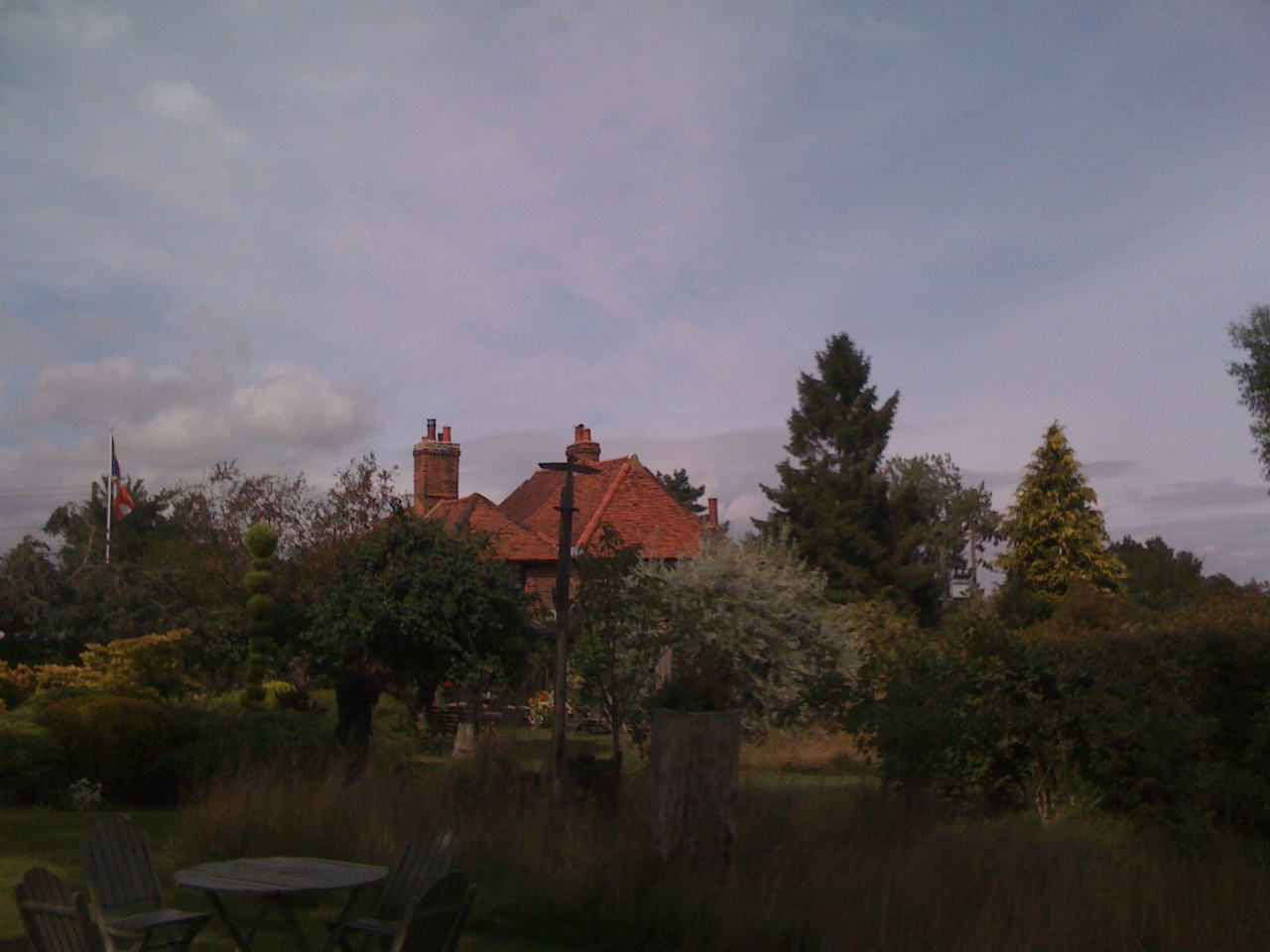
I couldn’t hear any response, and I sure as hell wasn’t going to simply barge in. I know this is an open house (or, I should say, I’ve read as much), but it’s still not my home, and I suppose the confining categories of private property are inescapably imprinted in my mind. Perhaps this feeling was also a product of the very isolation of the house, and I began to question just how ‘open’ a house could be when it was so difficult to find. I waited to be invited. While waiting for an invitation, I peaked around to the plush rear garden, full of characteristically English green shrubbery and trees, and there was also an explosion of reds, purples, whites, and yellows in the blooming flowers. At first glance, I noticed that many plants were overgrown, ascending the side of the brick building, and the grass was knee high. The more I looked, however, the more the signs of intense labor jumped out, in the cleared path between the tall grass, potted plants, neat rows of veggies and herbs, and the arrangement of a dark wooden picnic table, a reddish rusted fire pit, and various other rusty benches and chairs.
The house itself was an old yet sturdy Victorian cottage of brick construction with a shingled roof of various dark burgundy reds and browns, wood framed windows each slightly ajar for ventilation, and brick chimney with an orange clay top. The house had clearly been subject to various repairs, as none of the windows matched, and there were areas of brick that stood out as more brightly orange than the surrounding older, blood maroon wall. The house stood in jarring tension with the avant-garde and post-modern paintings and sculptures that populated the garden and the walls of the property’s buildings. Nude dolls covered in mold and green moss nailed to tree stumps, painted ocean waves of turquoise and white on a side of a dilapidated shed, and a sphere made from broken tiles interrupted the otherwise bourgeois country visual of the garden. Some of these pieces were faded and rusty, while others were freshly painted. The past and the present blended into each other in these clashes.
Inside the house I could hear approaching voices, and then a woman that I instantly recognized from photos as Gee Vaucher walked to the door. She had long, flowing hair of solid, almost metallic grey, and deep-set, piercing eyes softened only by the gently protruding bags of freckled white skin underneath them. We entered through the low door after being invited in, engaged in a somewhat awkward round of introductory pleasantries in the narrow, unlit kitchen.
“Should I make some tea? Coffee? Or…” Gee asked and her voiced trailed off. The offer of tea seemed to be an automatic response to the appearance of visitors, as Gee had asked without any hesitation. There was clearly a ritual for how people were welcomed into this house.
“Tea’s great for me,” answered Tom.
“Yeah, I’m good with tea, thank you,” I added.
“Sure,” Gee answered.
We went outside to the garden and set up the seat covers on the picnic benches that Gee had indicated. The sky still threatened rain, so if we were going to enjoy the garden it would be while we had this tea. I definitely wanted to spend a bit of time in the garden, and it seemed like the place most conducive to talking. The house was laid out in such a way that if we all went inside, we might lose track of each other. Winding, twisting hallways, unlit rooms, and multiple floors and stairways sprawled out from the doorway. If we went inside for the rest of the afternoon, I worried how isolated my visit might become. In a few moments, Bill appeared in the doorway, slightly hunched over, and carrying a tray loaded down with a kettle, four mugs, spoons, and a few small milk cartons. We all sat down, fixed our tea, and began to talk.
“What have been up to today?” Bill asked Gee.
“Oh, I’ve just been working in the studio. I was rather hoping no one would come today,” Gee replied, “been working on a new book about knots,” and she paused to place her hand softly on Bill’s forearm, “I’ve got a few pages you can read if you’d like.”
Bill nodded a reply while sipping some tea with a slight slurping sound.
I, on the other hand, gulped down a large mouthful, and felt the hot tea burn all the way down my throat. I suddenly felt invasive and uninvited (which, I suppose I totally was), so I rushed to tell Gee, “Well, I can finish this tea and move on. I certainly don’t want to impose.”
“Oh no, it’s fine, don’t worry. The house is open, so we’ve got to always be ready for visitors,” she replied, “we have lots of empty beds, no one else is here now, though we are expecting a few people tomorrow. A workshop for kids’ art. But you can stay for one night.”
“Well, ok,” I answered somewhat sheepishly, “do you still get visitors often?”
“Nearly everyday, yeah,” Gee answered, nodding her head slightly.
“What about fan mail?” Tom asked.
“Ah…” Gee’s voice grew soft, “some, yeah. I’ve been writing recently to this American in prison about Crass, and he just got out, so I’m going to send him some stuff. But nothing like the old days when we’d get bags and bags. We used to have a whole day once a month when we’d all sit in the kitchen and answer it all.”
“Well, I mean, that what it’s all about isn’t it? I mean, that showed that Crass was for real,” Tom said.
“I just think it’s rude not to answered a letter. It’s different with email when you get loads of nonsense, but letters are different,” Gee answered, sounding more pedagogical than radical.
“Does anyone mind if I smoke?” Tom asked as he removed some crinkling loose papers and a small bag of tobacco from his pack.
“Sure, as long as it’s not drugs,” Gee answered, “we don’t allow drugs here.”
“No, no, just a cigarette,” Tom said as he opened the bag to display the golden tobacco inside, and began rolling a cigarette.
Gee explained further, “Yeah, we don’t allow drugs here because we’re really sitting targets, always have been. If we’d had drugs here during the Crass days they would’ve shut us down in five minutes.” The imposition of rules at a proclaimed anarchist space is striking in its contradictory oddness, yet she did have a point. Crass had been the subject of state surveillance and meetings of British Parliament in the 1980s.
“Do you still have anything from the Crass years?” I asked hopefully, for this was why I’d come.
“Not much, except the paintings. I’ve never sought commercial success, and I can’t bear to sell any of my work, so I’ve got it all. Would you like to see them?”
“I love the painting for the Feeding of the 5,000 album cover. It’s a painting right? For years I thought it was a collage.” I said, growing more eager about the chance to see the original art for the replicated images I’ve seen thousands of times.
“Yeah, yeah, it’s a painting,” Gee said, “Oh wait, I don’t actually have that one right now, it’s loaned to an exhibit on Crass’s influence on, oh what’s it called? Not punk, but another music sort that’s just fast and loud, well noise really…what’s it called?”
“Grindcore?” I offered.
“Grindcore,” Gee affirmed with a laugh, “Yeah, that’s it. Anyway, that’s where the Feeding cover is. But I’ve got Bloody Revolutions if you’d like to see it later.”
“Of course! I’d love that.” I replied.
We sat enjoying our tea and the conversation switched to mundane consumer politics as Bill, relaying his recently travel woes stated “these bastard airline companies charge you a fortune, and now they not only make you pay for bags, I heard they won’t even allow bags much longer.”
“No bags?! How will people travel then,” I asked.
“Just carry-ons, that’s what we’ve heard,” Gee answered, getting up from her chair, “I’ve got to let the chickens out.” She walked around to the coup, opened the door, and with a burst of youthful energy ran out into the garden, flapping her arms, and saying, “Come on girls.” The chickens clucked happily as they followed her, seeking all of our attention by running underneath our legs. Again I was overwhelmed with more farm vibes than punk vibes.
“Can you watch the chickens, I’d like to go work in the studio a bit?” she asked me.
“Sure.” And so I sat there, reading Dostoyevsky, occasionally looking up at the hens. What, if anything, could I comfortably call ‘punk’ in this setting? Was there any similarity I could draw with the punk spaces I typically inhabit? Could I even imagine the thousands of crust punks, street punks, and anarchists I had seen wearing the Crass logo on their stud jackets, jean vests, and tattooed skin in this scene? Perhaps I had unintentionally been engaged in problematic and uncomfortable essentialism, flattening out my own understanding of what punk was and could be.
“This is luxury with a capital L,” Bill said as he reclined further in his lawn chair.
“Yeah, it’s really nice here,” said Tom, “exactly like I imagined.” I didn’t respond, but started to remember all that I had read of the place, the people who live here, and the politics represented. I couldn’t say that what I found was entirely surprising, yet there was opulence I hadn’t expected. Aside from Gee’s paintings that she had dug out of crates to show me, there was no visual indication of punk. Crass seemed to be a distant memory at Dial House. Nor was there any signs of radical politics aside from the words that dripped out of the residents’ mouths. I was mistaken to expect them to be wearing their politics on their sleeves.
“How do you know about this place? Just from Crass?” Bill asked.
“Yeah,” Tom answered, “when I was a kid I was listening to a lot of punk stuff, but I had really bad taste in music, like the Casualties and stuff. Then some older punks started showing me some better stuff, and introduced my to Crass, Christ: The Album actually. Since then I’ve been a big fan of Crass.”
“How old are you?” Bill asked, raising his eyebrows and leaning forward as if to tell a joke.
“25,” Tom answered.
“Well…” Bill said, but then his voice failed for a moment due to laughter, “they stopped playing in ’84, before you were born.”
“Yeah, me too,” I said, “but they’ve influence so much within punk.”
“They did so much, changed so much, I don’t think there will ever be a band that influential again,” Tom added.
We sat chatting for a while about punk, prisons, and Angela Davis, when suddenly Gee reemerged from the house, asking “Would anyone like to wash some spuds?” Tom and I washed fist size potatoes from the garden while Bill snapped green beans.
“There’s far too much bean being wasted here!” Gee exclaimed as she picked up the discarded ends, “Waste not, want not.” Bill must have been surprised at Gee’s use of this cliché.
“What?” Bill asked in a high tone.
“You don’t need to do the bottom, just the top,” Gee answered, demonstrating on a couple beans for Bill’s benefit.
“Mmmm, alright,” Bill replied in agreement, seeming more surprised than annoyed.
Once the beans and spuds were prepared, Gee put these all into the oven, and lead us back outside to assemble firewood. While Bill, Tom, and I were finishing the assembly of the fire, Gee appeared sheepishly in the doorway, “Andrew, would you like to see these paintings?”
“Aw yeah, that would be great!” I exclaimed.
She led me into a large room with a bare, exposed concrete floor. Overtaking one entire wall of the room were two large wooden desks, covered with miscellaneous sketches, papers, and open books. The rest of the room was open, with only scattered easels and a few filing cabinets. Cans of paint and brushes were scattered in disarray on the floor. There was no lighting in the room aside from the faint yellow beams of sunlight that snuck through the windows.
Gee dug for a moment in a dusty box, pulled out a framed painting, and set it on a counter for me to see. I leaned over the familiar image of Bloody Revolutions to look closely at the brush strokes, and see all of the contextual details that were cut out of the reproduction of this image on the 7” record that was released. It was a black and white painting that from a distant had the realistic quality of a photograph. Queen Elizabeth, the Pope, Lady Justice (from the Old Bailey in London) and Margaret Thatcher stood in street clothes on a graffitied street corner. The building they were leaning on had a graffiti stencil painted on it that had the Crass logo and said, “Who do they think they’re fooling, you?” This stencil was distributed in some of their earlier LPs, and the band encouraged fans to paint them over advertisement. I pictured the album art to Stations of the Crass, which was a photo from a London Underground station that had several Crass graffiti tags on it. The image in Bloody Revolutions, however, was not only political and playfully disrespectful of institutional figureheads, but also turned a critical eye toward punk itself. The four figures are positioned and clothed in reproduction of a famous Sex Pistols band photo from the time, only with the heads changed to the political figures. The song itself was an indictment of the totalitarian left, a bold stance for punk at the time, but a stance that Crass took in conjunction with their attack on the conservative right.
“Wow, the detail…” was the most intelligent comment I could offer, and with a laugh, “I’ve always liked the dog here.”
“Ah, the Queen’s corgi?” Gee asked and joined in my laughter. “I also have this one,” she continued as she pulled out her Oh, America painting. This image was a small painting, no larger than a sheet of notebook paper, and was of the famous Statue of Liberty in New York. Only, in this painting, Lady Liberty has her hands covering her face in sorrow while destruction and disarray signified by black, blue, and pink smoke and clouds surround her. It was the cover art for a Crass record that was never released, a recording of a poem imploring the U.S. to cease their warmongering and engage in actual politics of peace. I stood admiring the paintings a bit longer, and finally Gee asked, “Do you do much with art?”
“Uhh,” my voice went up as I hesitated, “I play music, that’s it really. As far as painting and drawing go, I mean, I’ve tried it, I’m just not very good at it.” I had said these words through uncomfortable chuckling, and when I was finished, Gee laughed at my response.
Eventually, our dinner of beans, potatoes, and vegetarian pies was ready, and we sat in front of the fire eating. Aside from the peaceful deep, relaxing breath of the rustling of the leaves blown in the trees, the hissing and popping of the firewood, and the gentle buzzing of bees, there was an occasional sonic interruption that violently imposed itself upon our conversation. Loud bangs rang out in a short sequence, and each time they did I expected to see a bird fall into the garden, or morbidly into my lap.
“Now that it’s dark, I’m not walking back to the bus stop. With all these damn hunters, I don’t wanna get shot!” I said.
“Oh, they’re not hunters, those are bird-scarers. When you hear one, wait just a minute more and you’ll hear another. Yeah, the farmer puts them out there.” Gee explained.
I breathed a sigh of relief that we weren’t actually surrounded by guns. It also provided an interesting metaphor for thinking through aesthetic experience, i.e. the visual splendor of the unspoiled fields brought about in part because of the sonic violence of these devices.
“What is it you’re writing, about anarchist music?” Gee asked me, to which I responded that week’s version of my project, some amalgamation of Nietzsche, Foucault, Marx, aesthetics, authenticity, resistance to normative power relations, etc. She told me she didn’t know Foucault, but had read some of the other writers I mention, but with some reluctance.
“I don’t like just believing any writer. Not entirely anyway. Just like history, I don’t believe in history,” she told us. “For if you look at accepted history, it’s all bollocks. Just like I don’t believe in revolutions, because, well, they always go wrong don’t they? They aren’t about the people when it’s all said and done.”
“As far as I’m concerned, you have to start with your own life,” I replied, “but when I read Kropotkin, I have to admit I still get excited about revolution.”
“Sure, yeah, you do have to start with yourself, but then you have to look to the people,” Gee answered, getting up to discard her plate on the far end of the table.
Bill had fallen asleep on his chair, but jerked awake as Gee walked by.
“Oh, sorry love,” Gee said, “didn’t mean to wake you.”
“It’s alright,” Bill answered, “I think I’ll turn in.”
“Would you like to stay in the caravan, or would you like a room inside?” Gee asked.
“I’ll have a room inside thanks,” Bill answered, “is my old room available?”
“Yeah, and there’s some books in there if you want,” Gee said.
“I do have some trouble sleeping sometimes. I usually only sleep three-four hours a night,” Bill said, “but I brought some books as well. Goodnight.”
“Goodnight,” was the chorus that Gee, Tom, and I answered.
Bill went inside while Tom and I began to gather soiled dishes and carry them inside the house. We washed the dishes and turned in, and the rain never did come.
In a way, my visit seemed very similar to seeing old friends or distant relatives. I was welcomed, given a meal and a bed, and had some chores to do (voluntarily of course). Yet, this was not the home of people I knew, but only knew of. I had been welcomed just as the reputation of the place had promised. I felt hopeful, if perplexed, upon leaving. It seemed like a sort of sanctuary more than a radical space. I certainly could not see any societal changes coming out of here. The residents of Dial House had certainly changed their own lifestyles, though they weren’t as ‘off the grid’ as I had imagined. They still had utility payments, which I was made aware of when Tom asked to bathe and was told that hot water was too expensive. But, they had avoided the corporate world as much as anyone I had met. They seemed to live on their own terms, even if these terms were offensive to others or inconsistent with what more hardline anarchists might accept. I began to wonder how many countless other visitors had come here and felt similarly, and I wonder how many anonymous lives may have been changed by the simplest of country pleasures at Dial House.
Yet, as I was riding the train back into London, I also considered what a privileged space it was, for Dial House was owned by the residents. This was no small house, nor small tract of land. Authentic living as defined by these folks would be limited to those with access to an incredible amount of resources, support, and let’s face it, money. How available would this type of lifestyle resistance be to anyone that doesn’t come from a privileged, wealthier background? I sat in the Tube pondering Murray Bookchin’s critique of lifestyle anarchism, and tried to figure out ways to reconcile such anarchist withdrawal with the goals of revolutionary societal change.




 Profane Existence