The long awaited debut LP from NYC’s FLOWER “Hardly A Dream” is finally set to arrive.
FLOWER’s tedious approach to writing/creating/drawing their debut LP was carefully thought out and the result is a monumental anarcho punk /crust record.
“Hardly A Dream” Takes us on a bleak journey through the dark side of society. As soon as you drop the needle a dark atmosphere is immediately created with a slow intro featuring arpeggio guitar work that builds into pummeling d-beat crust. The albums vocals then leave you with a feeling of being crushed by the ever-present weight of living through our modern world of late stage capitalism that was built on the falsehoods of the so called American dream, religious hypocrisy’s, nationalism, and the greed of humankind.
FLOWER take many cues from predecessors and are most often (and rightfully so) compared to NAUSEA but they also take a heavy influence from ANTISECT, SACRILEGE & other greats. The artwork has a very RUDIMENTARY PENI feel and the record comes with an amazing 24.5 X 34.75 CRASS style poster jacket. All art work was meticulously hand drawn and overseen by the guitarist Willow in true DIY style and spirit. Willow was also cool enough to draw up a special shirt for the record release featuring an alternative PROFANE EXISTENCE backprint!
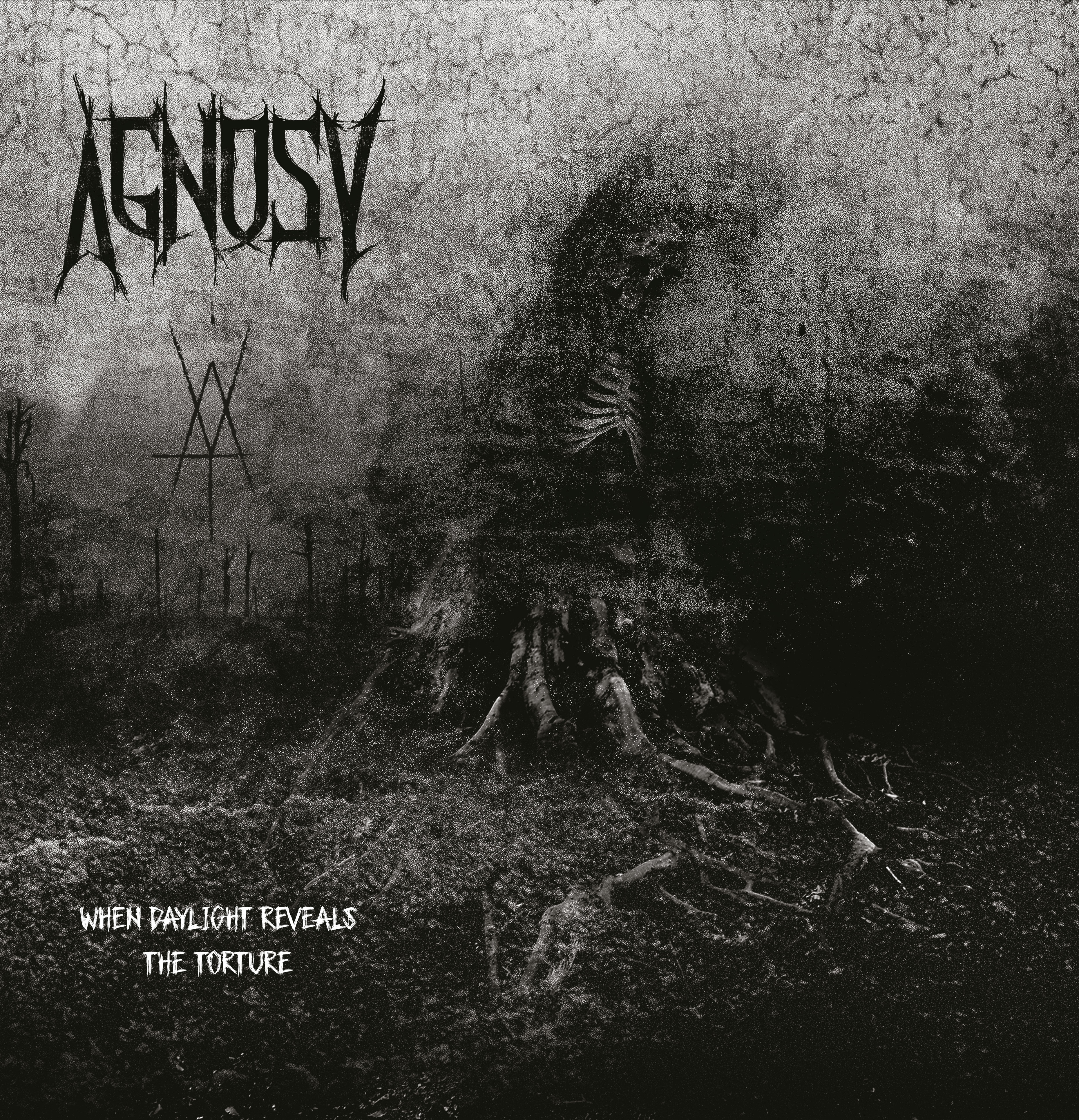
Dark, heavy, galloping crust from the streets of London. AGNOSY is back to present us with a ferocious beast of an album that can only be forged by the anger and frustration of living in today’s world. “When Daylight Reveals The Torture” aggressively attacks evils such the current rise of fascism and animal abuse. It intelligently and passionately touches on the Afrin invasion and the revolution in Rojava and shows nothing but utter disgust toward the arrogance of humankind’s lust for greed and power that will inevitably lead us down paths of war and environmental devastation.
AGNOSY – Live at SCUMFEST in London. 2011
While lyrically AGNOSY are much more politicly straight forward this time around than on previous releases, musically they have expanded on their sound to create a dark and moody atmosphere while at the same time staying crust as fuck. To say they know what they are doing would be an understatement from this band of vets whose members have played in HIATUS, HEALTH HAZARD, and BEGINNING OF THE END.
Long galloping intros are followed up by traditional d-beat, fierce solo’s are then meet with vicious vocals and pulverizing bass in a brilliant recording captured by Lewis Johns at The Ranch Production House and was mastered by Brad Boatright at Portland’s legendary Audiosiege. We then pressed on deluxe heavyweight 150-gram vinyl, printed on reverse board jackets, and included an 11in x 22in gatefold insert to bring you a high quality and truly epic record.
PROFANE EXISTENCE – PO BOX 647 – HUNTINGTON WV – 25711 – UNITED STATES
The legendary crust classic is now available once again!
Authorized and released in cooperation with MISERY, S.D.S., & MCR Japan & Remastered by Jack Butcher at Enormous Door Studio we are beyond proud to make one one the most rare and sought after crust records available once again.
Fuck the scavengers charging punks exuberant amounts of cash on ebay and discogs. We worked meticulously with both bands and with Jack at Enormous door to bring you an updated version that kicks major audio ass while maintaining the original authenticity.
Released on deluxe 150 gram vinyl. With an 11×11 inner sleeve. Black Paper Jacket. Reverse Board Jacket.
Earlier this year we re-issued this legendary LP and sold over 950 copies in just 4 short months. For this second pressing we pressed 490 copies on Krystal Clear & 485 on Grey Vinyl with Black Mist.
Crystal Clear (Bullet belt no included) Grey With Black Mist (Bullet belt no included) PROFANE EXISTENCE – PO BOX 647 – HUNTINGTON WV – 25711 UNITED STATES
Stench crust the way it was meant to be played!
The UK crust scene of the 1980’s inspired band after band but no other band has ever reincarnated the sound of that time as well as SWORDWIELDER. Quite simply if you like crust, then this the album you have waited decades for.
Review by Craig Hayes from “Your Last Rites”… Swordwielder – System Overlord Heavyweight punk fanatics take note: System Overlord is a fucking triumph. The long-awaited sophomore album from Gothenburg stenchcore band Swordwielder is a brooding behemoth, constructed from the filthiest and heftiest strains of punk and metal. System Overlord shimmers with apocalyptic visions, and it’s overflowing with all the grim atmospherics and intimidating intensity that defines consummate crushing crust.
Too much hype? No way… And no apologies, either. Swordwielder deal in definitive stenchcore on System Overlord, and much like their full-length debut, 2013’s Grim Visions of Battle, the band’s latest release is a knockout. Swordwielder’s harsh, gruff and dark sound owes a significant debt to old school icons like Amebix, Axegrinder, Deviated Instinct, and Antisect, and they mix and mangle their influences and leave ’em to rot on the battlefield.
Plenty of hammering rage drives System Overlord tracks like “Violent Revolution,” “Savage Execution” and “Cyborgs,” and thundering epics like “Corrupt Future” and “Northern Lights” exhibit subtler strengths, mixing guttural growls and clean vocals with crashing percussion and dirge-laden riffs. Connoisseurs of corpse-dragging crust will love the brute-force belligerence of “Absolute Fear,” “Nuclear Winter,” and “Second Attack,” which rain down like merciless mortar barrages. As a rule, all of System Overlord‘s mammoth tracks chug and churn with grinding muscle, while reeking of squalor and decay.
Swordwielder exudes tightly coiled aggression from start to finish here—songs rise from the ashes of desolation, and resounding calls for action and resistance ring loud. If you’re a fan of heavy-hitters like Fatum, War//Plague, Carnage, Zygome, Cancer Spreading or (insert your favorite hefty crust crew here), System Overlord‘s trampling tempo and strapping sound are bound to appeal.
WILT combine old school metal and crust in a perfect hybrid that very few others have ever achieved. Prepare for a LP thats equal parts galloping d-beat crust reminiscent of bands like HELLSHOCK, and INSTINCT OF SURVIVAL, meets old school death metal in the vein of BOLT THROWER, MEMORIAM (old) SEPULTURA.
Here is a track from the upcoming LP
“Sermon for the Bootlickers”
Despite the inculcation of helplessness within each there remains great power. Ill at ease with such makes us ill. Learn to see the hand that feeds for what it is. You’ve been fooled if you think you’ve got no power. Refuse to be reduced to a consumer you’re a human being. Define yourself by more than wealth. Define yourself as a human. You don’t need what you’re being sold. Bend your knee to no authority but your own mind. You have the power to avoid the gilded trap. Avarice is what you’re conditioned for. Break the mold discover what’s really valuable to you.
WILT will be on in Europe this July / August will ELECTROZOMBIES From Chile
Wed, July 12 Hanover / Germany / Confirmed Thu, July 13 Bremen Fri, July 14 Mulhem / Germany / Confirmed Sat, July 15 Gent, Belgium / CrustPicnic / Confirmed Sun, July 16 Paris / France or Amsterdam / Nederland July 18 North-East France or West Germany July 19 Freiburg / Germany TBC July 20 Winterthur / Switzerland Fri, July 21 Zurich / Switzerland Sat, July 22 Biel / Switzerland July 23 Lausanne or Geneva / Switzerland
July 24 Geneva / Switzerland or Grenoble france
July 25 Treviso (or Milano or Bologna or Verona) / Italy
July 26 Ljubljana Slovenia Confirmed
July 27 No Sanctuary chilling day
Fri, July 28 NoSanctuary Confirmed
Sat, July 29 NoSanctuary Confirmed
July 30 Ilirska Bistrica/Slovenia or Vienna/Austria or Budapest/Hungary.
July 31 Wiena / Austrai or Budapest or / Slovakia
August 1 Brno / Czech Republic.
August 2 Prague / Czech Republic
August 3 Finsterwalde / Germany TBC
Fri, August 4 Leipzig / Germany TBC
Sat, August 5 Berlin / Germany / confirmed
August 6 Dresden
August 7 Wroclaw / Poland
August 8 Warsaw / Poland
August 9 Poznan / Poland
August 10 Szczecin/Poland TBC
Fri, August 11 Rostock / confirmed
Sat, August 12 Hamburg TBC
For this in the Seattle or surrounding area you can catch WILT this Saturday April first at Highline Bar with NOOTHGRUSH from Oakland.
With the rise in popularity of the ideas of urban gardening, deep ecology, and permaculture amongst activists, anarchists, and subcultures such as punk often questions of ethics seem to have become simplified to the equation of SUSTAINABLE = GOOD. Yet often all kinds of cruelty can be hidden behind the veneer of that buzzword sustainable.
The unfortunate reality is that simple fixes rarely offer much beyond false hope and easy ways out. Perhaps they help people to ease their personal guilt by assuming they are not part of the problem (everyone else is), but is this any more than a self serving delusion?
The farm I grew up on near Kitscoty Alberta. This picture looks out the window of my mothers bedroom over the garden and barnyard
I grew up on a small family run farm in Alberta, 10 miles north of a town you have likely never heard of, with a population under 700. My mother grew up on that same farm with her two brothers. Her dad and his family lived there for many years, they had immigrated up from Nebraska where the family had farmed for a few generations since their original migration from Scotland, where again they had been farmers. It would be fair to say that farming is in my blood, so to speak (or perhaps I have just been reading too many Vampire The Masquerade books as of late?) Either way, I feel at least semi-competent to write about some of the ‘sustainable’ realities of small scale farming, drawing on my personal experiences.
I have many memories from growing up on the farm, from playing in the garden and eating carrots straight out of the ground with the dirt still on them, to collecting eggs from the chicken house, or chasing the turkeys for fun, being chased by the turkeys (which wasn’t so fun), or moving cattle from one pasture to another by horse back. There were some great memories too; picking saskatoon berries, wild raspberries that grew in the coolie, or building forts and campfires in the bush by the ravine. However, there were also just as many memories that were not so wonderful to look back on. Branding cattle with a hot iron as they screamed, or castrating steers — many city folks don’t realize you do not eat cows, and you do not eat bulls, you eat a male who had it’s nuts cut off so the flesh will taste better. All of which could be argued as sustainable.
Now I recognize that not all this is relevant to the popular trends I see amongst self styled alternative people over here on the west coast, as most of the folk punks are more into having pet goats and living on boats rather than farming beef or dairy cattle for auction. So I will try to keep more focused on the aspects of small scale farming that would be more of interest to the DIY crowd with their fantasies of farming and sustainable farming.
Chicken Squawk
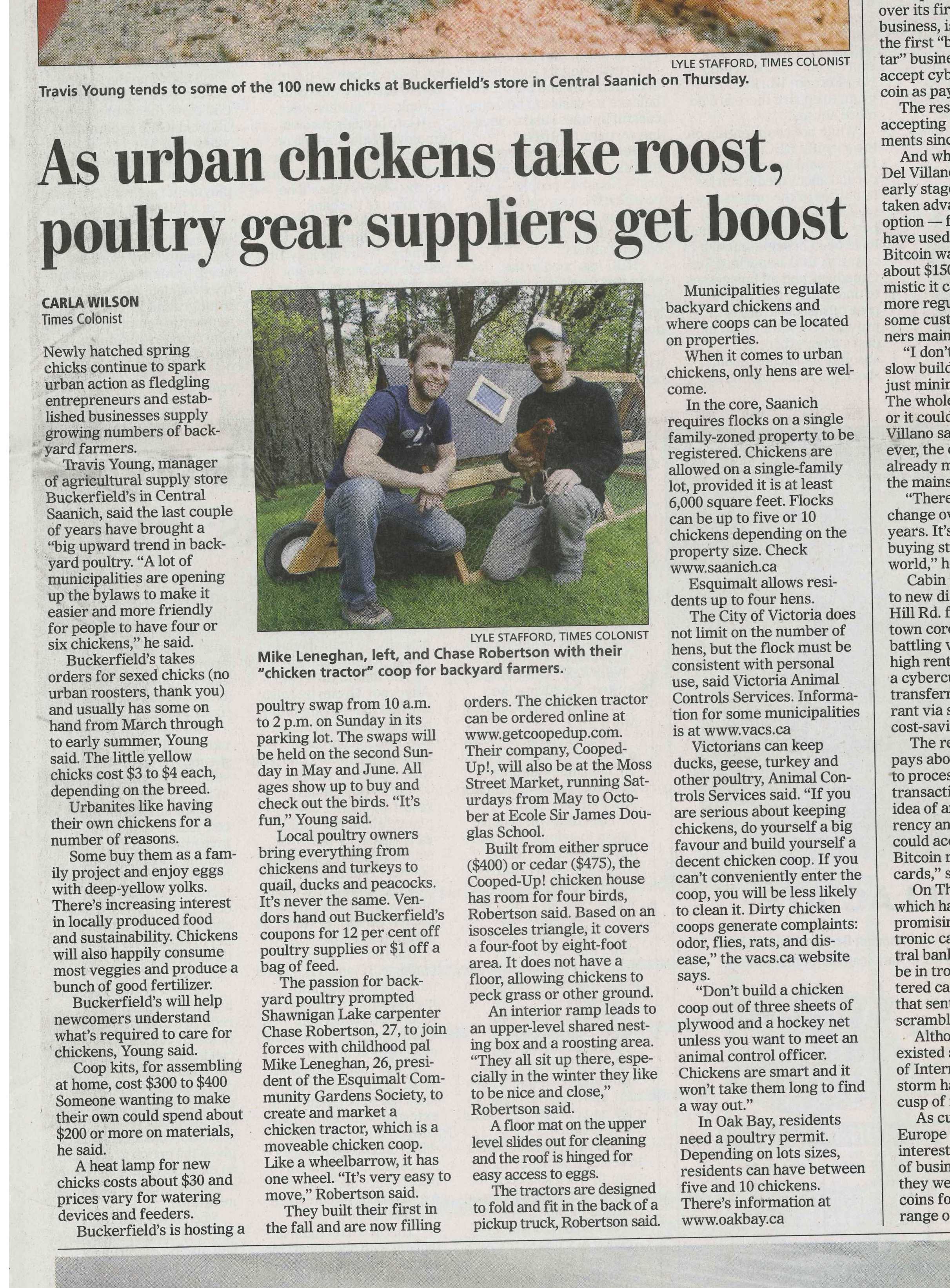
One of the more popular trends amongst the urban radicals is having back yard chickens, to collect and eat their eggs. Where I live, in the Cascadian bioregion, it has become almost as cliché to have 6-10 birds pecking around your back yard of your community house as it has to wear Carhardts, have a large dog, and all black clothing, or to play banjo. Unfortunately, I also live in an area where one thing that is not popular is sticking around. The radical community here tends to be quite transient in nature, with lots of college kids, traveler punks, and others folks who often didn’t come from here and even more often don’t have much intention of putting down roots. This is a common frustration to those who are part of long term projects propelled by volunteers, but none the less, it has its pros and cons. However for the chickens pecking the dirt and laying those golden eggs, it is a much bigger problem. An average chicken may live up to 8 years, which is far longer than the school term, or even a bachelors degree. A quick peruse of Craigslist at the right times of year will give you a good indication of just how expendable these animals are to many of the people who are excited in September (at the beginning of the school term) to build a chicken coop for their back yard. But even for those who don’t intend to go traveling or tree planting soon as the summer hits, few want to care for a chicken until it dies naturally of old age. You see, chickens only lay a lot of eggs when they are still fairly young, as they get older they will produce less and less. For many of the urban agriculture enthusiasts, a chicken that doesn’t lay eggs is just work with no pay off.
But the plight of the urban chicken doesn’t end there — or more accurately; it doesn’t begin there. You see, chickens don’t just appear, and they are not brought by the stork to deserving families, they come from somewhere – or in other words, someone breeds them. Few of the breeds of chickens people farm have any resemblance to wild breeds, and wild chickens are pretty rare these days due to our destruction of wildlife habitat for cities and farm land; never mind that there was chickens, like Europeans, are an invasive species to this part of the world. So most of the domesticated birds come from a hatchery; either directly – or indirectly.
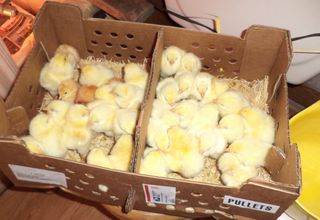
I remember how exciting it was for me as a kid to order chicks. We would get a catalog in the mail, with pictures of the full grown birds, and you would select them by recording the order number of which breeds you wanted to buy. A few weeks later, you would get a large cardboard box in the mail which would be chirping. Upon opening it, you would see it packed full of fluffy yellow chicks, divided and layered with cardboard dividers so they could fit more into each box. Every so often a couple would die while in the mail, so you would get a few dead ones in every box.Kinda like two scoops of raisins, right?
An important thing to note is, that they also were separated not just by breed, but also gender. See chicks are born about half females and half males, but most people don’t want to order males. Roosters don’t lay eggs for one, and for two, if you have more than one (or maybe two) roosters, they will kill each other. So the chicks are bred, the females are sold through mail order and the males are killed. Yup, right into the wood chipper. When people get back yard chickens, they often order from a breeder or hatchery. I know some get “second hand” or even call them “rescues”, but where do you think those birds came from before you got them? Buying chickens is putting money into the industry that breeds them for profit. This is the industry of commercial chicken breeders, and they are often the same places that supply big farms, as well as small farms and your average urban gardener with their new found interest in permaculture. And I didn’t even talk about the forced insemination.
Permanent Agriculture?
The study of words can reveal a lot. If you look at the etymology of the word Garden, we discover it is related to the German word for guard, and to words for walled, or closed lot. It doesn’t take a lot of thought to begin to see the relationship between these terms. As anthropologist Layla AbdelRahim explained in Wild Children – Domesticated Dreams, domestication requires the domesticator to control access to food and land. When you begin to garden a space, you must control what other species have access to that land or you will likely not have much of a crop to harvest. Whether we are talking about other non-human animals that might desire and easy lunch, or even competing plant species, insects, or other humans – gardening requires us to control what species are able to access the space. On an even more basic level, gardening usually begins with removing undesired plant species to prepare the land so we can plant seeds of the species we desire.
It has always amazed me how uncritically many Green Anarchists, Vegans, and Primitivists seem to embrace and support permaculture. Yet permaculture is in its essence another system of domestication rooted in anthropocentric desires. In other words, permaculture might be presented by its proponents as being sustainable (and therefore ethical) and based in local ecology, but in fact it is once again about human wants and needs. As well revered permaculturist Erik Ohlson explained in his interview in the book Tangled Roots: Dialogues Exploring Ecological Justice, Healing, and Decolonization, “Permaculture, which could be permanent—agriculture or permanentcultureis about designing human culture that is beneficial to both the land and to human at the same time.” That might sound great on the surface, but look at it a bit more closely and it follows all the same old patterns; humans are in control, Erik posits us as the managers and designers, and in the end it is about human needs first and foremost. Animals are not even acknowledged in this relationship, even though you would be hard pressed to find a permaculturist who doesn’t argue that domesticated animals are needed in order to maintain a healthy closed circuit. The implicit goal of permaculture is to make this human domination of wildlife spaces, plants and animals – sustainable and thus permanent.
I am fully aware that not every radical out there agrees with the anarcho-primitivist critiques of domestication, which sees domestication as not only the control of the wild, but also as the root of many other systems of domination such as patriarchy. It took me a long time myself to come to a place where I was open to those conclusions and the difficult questions they lead to. However there are many lenses to view the question of ‘sustainable farming’ through. From an animal liberation lens, another set of problems presents itself in that permaculture like other forms of gardening for human consumption involves turning wildlife habitat into farm lands that are exclusionary to certain wildlife, and even further permaculture also uses domesticated animals.
This is where it really becomes a problem for me, as it perpetuates the use and domestication of non-human animals for human benefit. But due to the SUSTAINABLE=GOOD formula, we choose to not see its implications for animals: both wildlife and domesticated. Often when I have presented these arguments to proponents of permaculture design, the response I get is akin to the lesser of two evils. The same argument often used to justify voting for shitty, racist, business friendly politicians.
I am by no means arguing that permaculture is worse for the land than monocropping, factory farming, or industrial agriculture, rather I am arguing that it is not the be all end all simple fix that many seem to desire it to be. Permaculture still means wildlife habitat is destroyed and used for human benefit that does not allow wild species full access and use of the spaces. Permaculture still involves captive breeding and continued domestication of animals for human consumption, whether it be chickens to scratch and turn the soil, or goats, pigs, or other species. Many of those animals will be from commercial breeders, and the care of those animals will continue to support industries that profit off of animal agriculture. Many of those animals will also still be killed in the end either so humans can consume their flesh and bodies, or because they have quit producing at the rates desired by the domesticators. Most of those animals will also be of breeds that simply did not exist in the wild, did not exist until humans interfered with their reproductive strategies to cause them to develop traits deemed more desirable. Did you know that wild pigs were never pink skinned, that sheep didn’t produce a harvestable amount of wool for hundreds of years after domestication, or that cattle bred for meat are different breeds than the cattle bred for dairy production? Wild cattle don’t produce as much milk, the animals we farm today are the product of thousands of years of selective breeding.
It is indisputable that modern industrial agriculture is anything but sustainable as it depletes the infrastructure of the landbase for higher temporary crop yields. Such a system by definition is incapable to sustaining itself indefinitely and would eventually lead to a collapse as once fertile croplands become less and less able to produce, due to nutrients in the soil being depleted. Technological fixes such as fertilizers may increase yields in the short run, but only work to deplete the health of the land in the long term. Permaculture on the other hand aims to be sustainable, which may be its most insidious trait. It seeks to make permanent the ability of humans to dominate the wild, and thus maintain industrial civilization. Advocates often argue that permaculture can allow us to use less land in order to grow crops to feed our populace (which is a population of not just humans, but also of the animals we domesticate for our use). However, promises of abundance aside, we live in a society of exponential growth. Capitalism is an economic system that requires such growth, both in profits and in populace which will consume the products of the capitalists. Permaculture does nothing to challenge or disrupt this growth, and in fact may allow it to continue far beyond the limits of industrial agriculture in its current form.
Capitalism kills animals. Industrialism kills animals. Civilization as we know it is based on the domestication of animals and destruction of the wild. I have no doubt that permaculture may live up to its promise of sustainability, I would even go further and suggest that many older practices of agriculture (such as crop rotation and choosing crops based on soil conditions) can also allow long term sustainability, yet like permaculture these techniques do nothing to challenge the relationship of human dominance, capitalism, growth, or cruelty to animals. The system always seeks to recuperate easy reforms in order to maintain itself. If we do not actively work to disrupt these power relations and include questions of ethics, sustainability will just become another way of hiding our violence and rationalizing our domination of other species.
At the very root of agriculture is the domination of other living beings by humans. At the very core of ethics is the question of domination and hierarchy. For me, any system that perpetuates these historical patterns is a system based on violence. I am always reminding myself that agriculture is a relatively new invention in the timeline of human existence. The world I would like to work towards in one that encourages and fosters the growth of wild species and habitats, not the subjugation of them.
I don’t know what the solution to all of this is, but I do know that if we hope for total liberation it can not perpetuate the oppression of others.
For those of interested in finding alternatives to these oppressive systems we need to consider more than simple solutions. Directness of our relationship to our food, and sustainability of our practices is only one part of the question we need to be asking. Another key question is, what is the outcome for non-human animals and for other species? Do the ‘alternatives’ we are promoting make any difference to the chicken in the cage? How about to the Wolf? the Trout? The Orca? Or Mycelium? Are they better off because of our actions? Or does our liberation continue to come at their expense? How can we begin to foster relationships that benefit wildlife? And how can we imagine our relationships to other species in ways that have the potential to be liberating and symbiotic?
Dumpster diving can be a blast, and a great way to get healthy food for many of us who were not born into class privilege. I don’t dumpster dive as much as I use to, but I have been doing it off and on since I first lived in a squat on the streets of edmonton, in 1996 at the age of 16.
I also have many friends and roommates who do the dive, and as awesome as it can be I have notice a few common trends and I feel like some folks might benefit from a little basic advice.
In Grime We Crust?
1) While there is many treasures to be found in the garbage, not everything in the bins is treasure. Often things belong in the garbage, sometimes way before they were ever thrown out. Products like Sunny D, or “Orange Beverage” which is sold for $1.00 when new, and tastes like watered down flat orange pop, belong in the garbage. Just because it is in the bin, doesn’t mean you need to take it out.
2) Leave some for other folks, you don’t need to take every scrap of edible materials from the bin. I know some approach dumpstering like it is their social mission to stop every scrap they can from hitting the landfill, but you gotta remember others might also be benefiting from that same store tossing their lunch. If you take everything, you might be taking food away from people who need it just as badly, or worse than you. If you insist on taking everything, consider going later, like 3am, after everyone else has come and gone, so that you are taking the leftovers rather than preempting others bin din.
3) Consider your social position here; if you have access to a kitchen, stove, oven, fridge and freezer – take stuff like produce which requires cooking and storing – and consider leaving products (like donuts, bagels, or pre-made meals in a package) that can be easily consumed without cooking for those who live on the streets and don’t have access to amenities.
4) Just because meat is in a dumpster doesn’t mean you have to put it in your body. Often I have seen formerly vegan or vegetarian kids start eating meat when they start binning, and rationalize it by claiming it would be disrespectful to the animal not to eat it… wait, did they actually just say it would be disrespectful not to eat an animal…? Yup that logical lunacy is a staple in the rhetoric of the ex-vegan ex. If you really respect animals, perhaps consider not viewing them as products to be consumed. Or better yet, join or start an group dedicated to animal liberation – above ground or clandestine – and take actual action to help living animals, or perhaps volunteer at the local rescues, sanctuaries, or adopt one from the shelters. There is so much work needed to be done and frying bacon out of a dumpster isn’t saving any animals, or your health, so quit making excuses. If you need to rationalize something, you probably shouldn’t be doing it.
It’s also just gross, all ethics aside. If you are consuming the flesh of animals from the dumpster, you are consuming torture. If you put torture in your body, don’t expect to get good health out. Never mind all the hormones, chemicals, and other crap. The flesh of domesticated animals from factory farms is simply toxic on so many levels. It always shocks me how people will get riled up about monsanto fucking with our food crops, or will refuse to eat soy because it is GMO, yet will fork flesh and puss (cheese) into their mouth 3 times per day.
4) Be picky. Dumpster diving is not a starvation economy, it is a fucking horn of pleanty. You can pick and choose and still bring home boxes of food most middle class yuppies couldn’t afford. So don’t eat shit, and don’t say thank you for the privilege. Take the good stuff and be healthy. Leave the garbage in the garbage.
Don’t put garbage in your body
The Dumpster Mafia – Organized Grime!
Simply eating garbage is by no means a revolutionary act, otherwise every seagull is a full fledged anarchist warrior leading the revolutionary vanguard! That doesn’t mean that dumpstering can’t be a ‘part’ of our anarchist practice. A few years back I had a roommate who really did try to make dumpster diving a revolutionary concept by applying ideashe learned from anarchist community organizing. He moved dumpstering from being just a lifestyle choice to actually using it to build community, organize, and increase food sovereignty.
He founded a group he named The Dumpster Mafia, it was organized similar to a CSA (Community Supported Agriculture) farm, and was by far the most organized and concerted dumpster diving I have witnessed or been part of. It involved a small team of volunteers, and anyone who either donated their time or a small amount of cash to cover costs, got a box of goodies hand delivered to their house every week.
The basic structure worked like this: he got a car given to him, a junker, which they would use to hit up the dumpsters, this way they could bring way more home in one trip, and could hit harder to get to bins out of bicycle range. In our backyard he set up a couple tents which he managed to get donated somehow, as well as a large chest deep freeze he got free off Craigslist. Beside the deep freeze, under the tents he had a series of good quality plastic bins, which he would use as refrigerators by filling plastic bottles with water to freeze them, creating diy ice packs, which were placed with food in the plastic bins under the tent (thus out of the sunlight). Food that needed to be frozen went in the deep freeze, produce and almond milk went in the bis, packaged goods like cereal just went in the house.
One group of volunteers would go dumpster each night of the week, using the car, and usually in pairs. They would go late so as to not take food away from anyone. They would process the entire bin, by taking out every garbage bag and piling them beside the bin, then systemically going through them one at a time taking out whatever food they could get which was worth bringing home, and finally placing the lightened bag back in the bin. Usually they managed to fill a car about 1/2 way by using this technique. They also would make sure to always leave the area cleaner than when they got there so as to not burn out their dumster supply by pissing off the stores.
The next team of volunteers would arrive in the morning, take the boxes of dumpster goods and process them: go through fruits and veggies that came in packages looking for bad ones to toss, or sometimes cutting off bad spots from fruit that could be eaten if frozen. Then they would place the food in the bins or freezer for the next group. The third group came by once per week, and would sort the scores into boxes to be distributed. Making sure to split food as evenly as possible. Finally volunteers would fill the car and make the deliveries to everyone who had contributed. Any money donated went to cover gas and insurance, although with 100% volunteer labor, very little money was ever needed, and the average volunteer only did about 2 hrs per week. It was a smooth operation for sure. And leftovers were delivered to a few local single moms down the block whenever possible, as well as to the local chapter of Food Not Bombs.
That entire year I barely bought food at all, and yet I ate fruit smoothies, stir fries, veggie bakes, and tofu scramble every day. It turned out to be a great way to build community, to get people working together, organizing, and it saved us all a ton of money. Plus we all were so healthy!
Get Dirty!
and remember, it’s even better when you do it with friends!




 see, chickens don’t just appear, and they are not brought by the stork to deserving families, they come from somewhere – or in other words, someone breeds them. Few of the breeds of chickens people farm have any resemblance to wild breeds, and wild chickens are pretty rare these days due to our destruction of wildlife habitat for cities and farm land; never mind that there was chickens, like Europeans, are an invasive species to this part of the world. So most of the domesticated birds come from a hatchery; either directly – or indirectly.
 Roosters don’t lay eggs for one, and for two, if you have more than one (or maybe two) roosters, they will kill each other. So the chicks are bred, the females are sold through mail order and the males are killed. Yup, right into the wood chipper. When people get back yard chickens, they often order from a breeder or hatchery. I know some get “second hand” or even call them “rescues”, but where do you think those birds came from before you got them? Buying chickens is putting money into the industry that breeds them for profit. This is the industry of commercial chicken breeders, and they are often the same places that supply big farms, as well as small farms and your average urban gardener with their new found interest in permaculture. And I didn’t even talk about the forced insemination.


 Profane Existence